

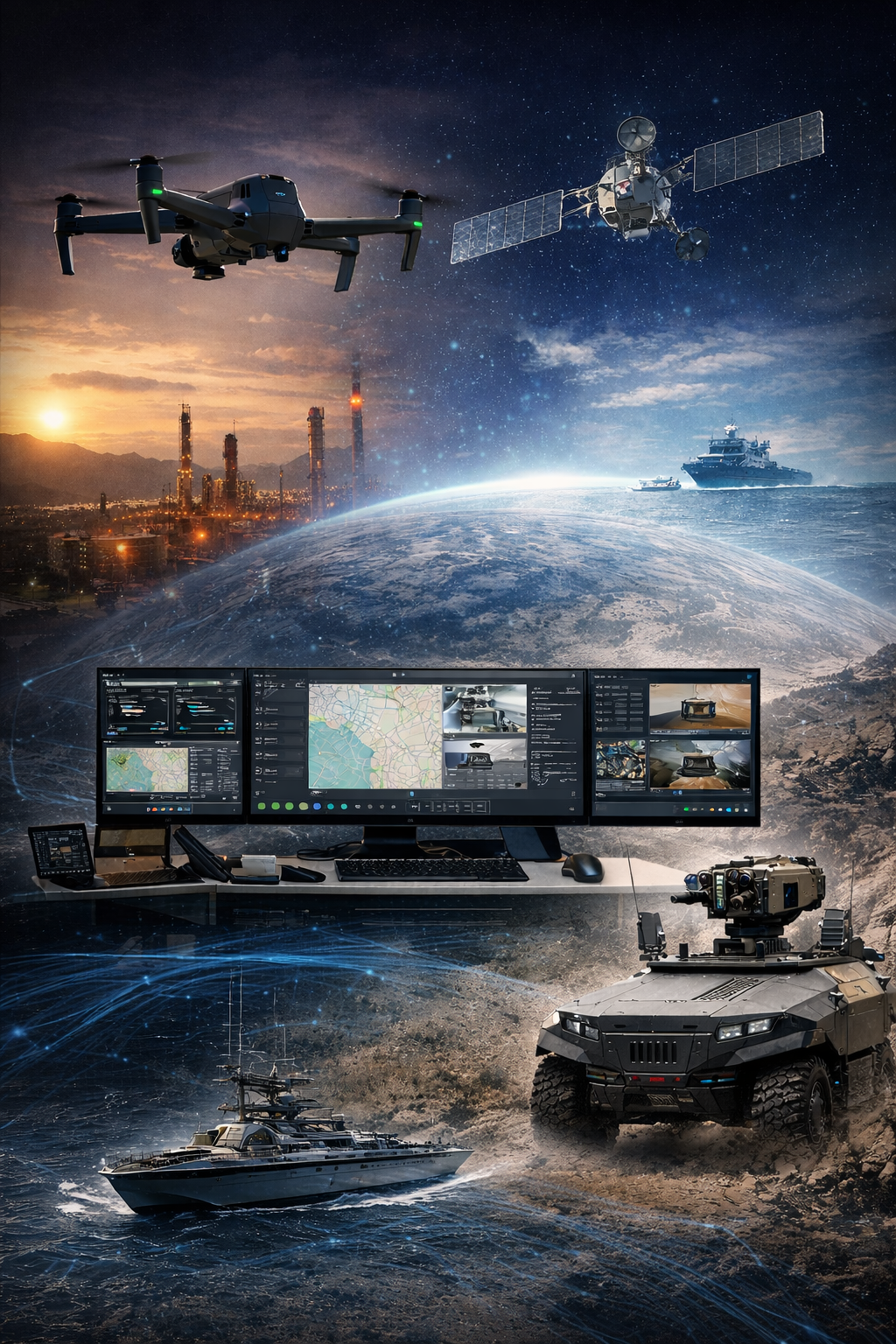
Multi-Vehicle Coordination
Manage multiple systems in a single flow. Vehicles move together, missions complete together.

Manage unmanned systems on a single layer.
unmannedOS is a unified software layer that manages unmanned system operations end to end.
It brings different vehicles, missions, and data into a single flow.
It works in the field — whether the link is up or not.
It makes operations faster, more reliable, and scalable.
Six core capabilities — unified into a single flow that works in the field.
Manage multiple systems in a single flow. Vehicles move together, missions complete together.
Manage air, ground, and sea vehicles in the same system. Every platform speaks one operational language.
Monitor and manage operations in real time. Decisions reach the field instantly.
Operations continue even if the link drops. Missions stay reliable, end-to-end.
Add new capabilities with applications. Grow with an expanding app ecosystem.
Grows from a single vehicle to large-scale operations. The system expands as your need expands.
The unit of command is not a vehicle — it is an operation.
You define an outcome-driven operation, not a single craft; the system arranges the execution itself.
Not manual control. Behavior.
Policies replace command streams; each platform reads its own state while the system coordinates behavior.
Air, ground, sea — one language.
A vehicle-agnostic abstraction; one mission carries the same semantics across every domain.
A capability is an application.
Third-party modules attach to the core like applications; sandbox, versioning, marketplace are built in.
When the link drops, the mission continues.
Decisions are local. The edge node owns the mission; the cloud is an optional observer.
One decision — in the field within milliseconds.
An event-driven backbone delivers decisions atomically to every relevant system. Latency disappears.
One core, every scale.
From one vehicle to a thousand, one nest to a distributed operation — the architecture grows, not rewrites.
Not a pilot. Not an operator. A commander.
You declare intent in natural language; the system structures, validates, executes, and reports back.
Not a test bed. The field.
Link loss, weather, contested airspace, constrained power — the system was born in these conditions.
New capabilities, never disrupted.
The core contract is stable; modules, models, behaviors update in place. Tomorrow's capability ships today.